Wednesday, September 22, 2010

Colour Project 1: Trial 2

After my initial failure, I decided the best way to re-invigorate the project for myself, I decided to I tried to step out of my comfort zone and buy a bunch of supplies, get an assistant and stage a metaphorical scene with objects, which I choose carefully for their assorted cultural/literary significance.

I took all of my collected objects (2 exact copies of each) and went to a nearby field. I then proceeded to destroy each object in a different manner, the destruction itself I filmed, making the process into somewhat of a performance piece itself. I then placed the mated object (the unbroken twin of the first) into the wreckage and photographed the scene.

Each photo was then going to be labeled with the metaphorical reference that the object was supposed to contain within itself. The point of everything was to speak to the idea that one always can continue on even through trials/hardship and in the wake of the destruction of the a value itself; that in my opinion, human will is insurmountable.

--------------------------------------------------


Unfortunately, after all this planning, preparation, and process, fate through a wrench in the works and while I was developing, the spool on which I loaded my film, fell apart, and thus I developed my negatives as one large chuck, thoroughly ruining them all. As such I had to rethink what I had done, and where I was/could possibly go.

Tuesday, September 14, 2010

Colour Project 1: Trial 1

For our first project, we all wrote words on a strip of paper and three were chosen at random. We then voted on which of those three liked best.
What was eventually chosen was the words Rebirth/Renewal.

After some consideration, I decided that what I wanted to do was to photograph a space over time; specifically, a space waking up. After some consideration of the possibilities, I decided that the best place to shoot this would be in the the Perlick Commons, a glass atrium, with a small cafe-counter, near where I live that is a popular breakfast destination for students. My plan was to show the renewal of both the space (as the sun rose) and the people (as they partook in breakfast).

When I finally went out, I set up at early in the morning, at approximately 7:00 A.M. and was there for 5 hours, (until 12:00 P.M.). My setup was relatively simple; I had two 35mm cameras (a Canon AE-1 and a Minolta X-700) on tripods with one facing towards the counter/door to the atrium and the other into the atrium where the bulk of the people sat. I then took one picture in each camera every ten minutes for a total of 25 images. Through I had to dodge a series of questions about what I was doing (usually pointing to the sign that said time-lapse art project in progress was enough) and defending my little enclave of equipment from the morning hustle and bustle, there were no real problems with the actual process of taking the pictures.

Unfortunately, nothing really worked like I had hoped. The main reason was that I encountered three large, distinct problems.
The first was that my AE-1 has a light leak problem. I had it fixed once, which stopped the issue from being a constant blight but eventually had to buy a new AE-1 due to the potential for ruined negatives. However, that camera was stolen a few months ago and my other 35mm were broken/out of batteries, so it was either run the risk, or no second camera. Some pictures did come out but none were really printable.
The second problem was that I changed the F-stop between shots. I did this thinking that I wanted to make sure that my first images were not under-exposed and the last not over-, essentially entirely for consistency. Unexpectedly, that is exactly the opposite of what I got. Essentially, the short of it is that what I was counting on to show the passage of time was the movement of shadows along the walls and floors as the sun rose, but with the change of the aperture, the shadows were perfectly clear in some, and completely gone in others.
The third problem was really stupid. I forgot to change the ISO on my cameras from 400 (I had been shooting Delta 400 for the past two months) to 160 for my Kodak Portra 160 NC, which meant that a good deal of my film was over exposed.

All in all, I was found the project very interesting conceptually and I did have a good time shooting it but after developing the film, I was very unhappy with what came out, even the images that developed well. Also, the entire process took so long and I didn't really have the time or energy to devote another five hours one morning to reshooting the project so I decided that since it only produced mediocre images anyway. I would shelve this idea away for another time and try to go in a different direction.

Saturday, September 11, 2010

Black/White "Colour" Print

Today in class we were asked to print a B/W negative using the colour process as a way to introduce us to the medium. Fortunately for me, I had already wet my feet in the colour process three semesters before and so it wasn't something that new/difficult to me.

The negative that I choose was incredibly boring and so in an attempt to make a more lively print, I tried to introduce an element of texture into the the print by scratching the negative.

Below is what resulted.

Monday, September 6, 2010

New Semester

This semester I am simultaneously taking two Studio classes at uni.
This is my first true dive into art here/in a long time/ever and I am fairly apprehensive about the prospects as I know the time commitments for both will be sizable and I am not sure if I have significant enough time to put as much into both of them as I would like. I guess all that I can is that we shall see.

The classes I will be taking (and thus the art that will most likely be posted soon are):
ARTS 072: Problems in Colour Photography
ARTS 054: Visual/Processes: Introduction to Silkscreening

Friday, December 18, 2009

End of Photography Class

For the past few months I have been taking a photography class on B/W Film Photography. I have thoroughly enjoyed the entire class and have definitely exponentially expanded my photographic skill base and knowledge pool. I am also beginning to understand what it means to have an expensive pastime. With cooking, you can always buy food cheaper or go to markets to get better deals, and even when that doesn't work, you can also just work with random stuff you have. However, that is not the case with photography. Especially when shooting film, the equipment (cameras and lenses), the medium (rolls of film), and the product (either computer programmes or photosensitive paper) becomes very expensive very quickly. It is possible to cut corners and such, but those "cost-saving measures" become very apparent, very fast.

However, for one of the first times in my life, I think I have really found a hobby - something that I feel okay spending inordinate amounts of my time (and money) on doing. On that interesting note, I started the class with one camera a 30+ year old Canon AE-1 with 50mm kit lens that belonged to my father, a flash that didn't work, a few filters, a 2x teleconverter, and a broken 75-210mm lens and now I own four camera bodies (two Canon AE-1, a Minolta X-700, and a Minolta SRT 101) four 50mm kit lenses a 28mm F2.8, 49mm F2.8, 135 F2.8 400mm F2.8 28-70mm F3.5-4.5, 75-210 F3.5, 85-205mm F2.8-5.4, 60-300mm F3.4-5.4, three 2x teleconverters, 4 flashes, an inordinate amount/variety of filters, two camera covers, three camera bags, a set of special glass magnifying filters, a mini-tripod, and three triggers. The best part about this is though family gifts and an amazing deal on Craigslist, I got everything I own for $120.

But back to the class, throughout the past few months I have been very busy doing work for it and trying to force my way through the learning curve for printing film. I have learned the hard way about all the various finicky aspects of film (light leaks, camera malfunctions, film inserted the backwards) and have spent countless hours reshooting and reshooting my projects. That being said, I have enjoyed every minute of it.

There is such an indescribable joy about walking out of a dark room after an entire night spent working with the perfect print in one hand and being greeted by the sun rising through the windows. It was those long nights that really made the class so worth it for me and because of that — even though it stole my life, even though I was always running around, and even though it is expensive — there is no way I will stop shooting film and taking classes.

The final assignment for the class was actually to upload all of the projects that I did during the class, with their accompanying statements. Additionally, what I decided to do was to upload all of my negatives that I didn't print for the projects to really round out my photographic journey.
The links to all of these can be found below.

In the end, looking back at the beginning of the class I came in thinking that I really knew photography even though all I had was trial-and-error and a good deal of intuition. Now that I have finished I have since discovered that those two are extremely important, but only one small part of a very big puzzle; More than anything, I have just re-enforced my belief that you can and should never stop learning, no matter what you're doing.

PROJECTS:
In all of these links you will find the various projects that I did for the class. Each one shows all of the final printed images and the negative scans from the projects, as well contains a link to the rest of the project negatives.


B/W Photography Project 2: Mapping Project

A map is an item that tells you about something. It can tell you about a space, a location, where to drive, or the torrid history of someone's love life. The point of this project was to choose something, and then, quite simply, 'map' it.
-- -------------------- --

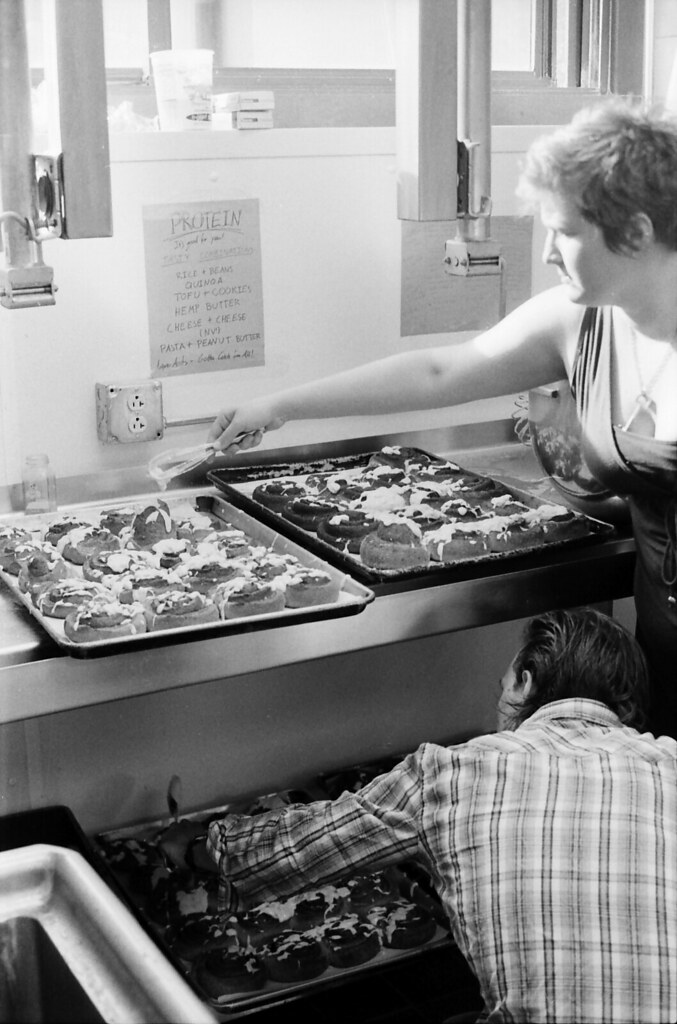
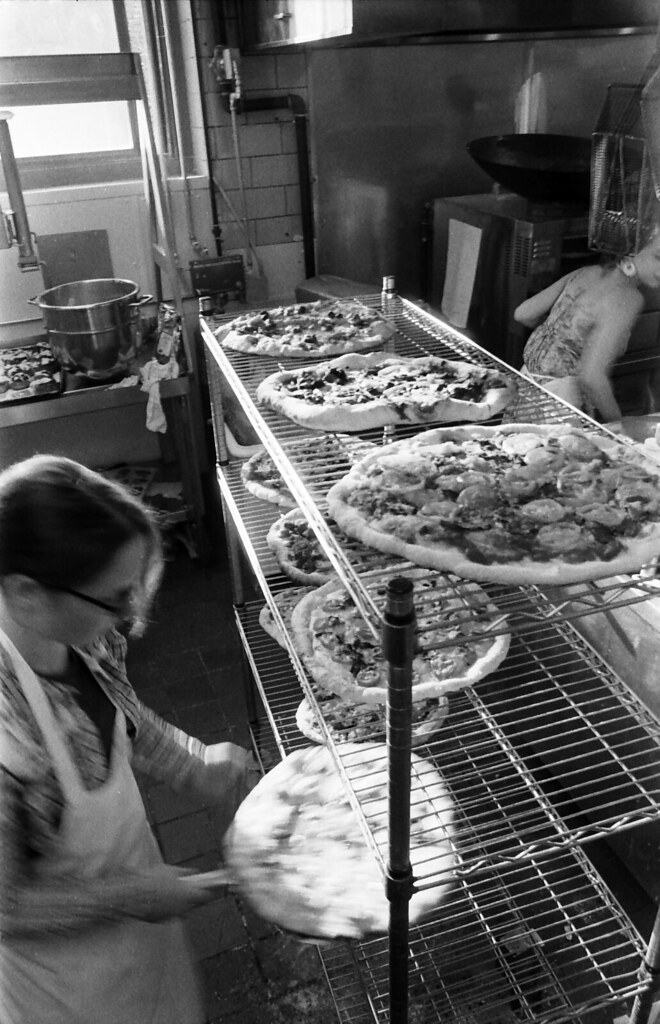
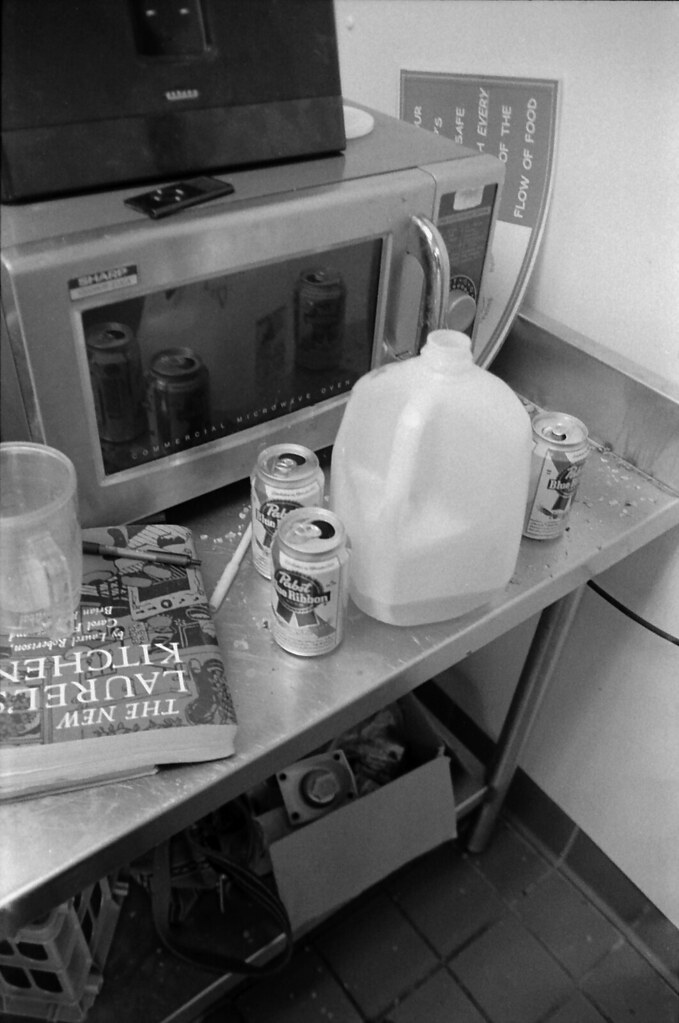
When I first head about the 'mapping' project, I decide that I wanted use Harkness Kitchen as my subject. Harkness is my house and I feel a deep connection t it, but a lot of people have a very skewed impression of what goes on there and who we are. Much of this project is about trying to rectify that by showing a different, more intimate view.

To this end, I shot, developed, and scanned nine rolls of film taken during all the meals, during clean-up crew, or after everyone had left, in the middle of the night. Unfortunately due to time constraints and problems with my negatives (light leaks in the camera, light leaks in the developing tank, old film...) I decided to greatly scale down my project from a holistic 15-20 image collage ranging from Harkness desolate in the wee hours of the morning to the hustle and bustle of our weekly 'Pizza Night.'

After a few hours of deliberation with the 180-200 negatives I shot (only about two thirds of which were fully viable options) I finally decided on a new concept: THE HARKNESS KITCHEN: an atmosphere unique.

In this, instead of a large scale project with many images, I really spent a lot of time choosing specific images I felt were really representative of the cooks, the atmosphere of cooking, and the camaraderie and passion of all the people involved with the cooking in Harkness. Each image was placed with intent and chosen to illustrate a specific aspect of the kitchen that I feel is important. Harkness is busy, complicated, but above all a real community of people who care about each other and I really tried to bring this out in my prints.

Enjoy.


B/W Photography Project 3: Emmulation Project

Some of the best pieces that have been made were based partially or wholly on preexisting pieces. It is also said that imitation is the purest form of flattery. Irregardless of whether or not these are true, for this project we were tasked to choice an artist or group of artists or style of art and then attempt to emulate it in our own work.
-- -------------------- --

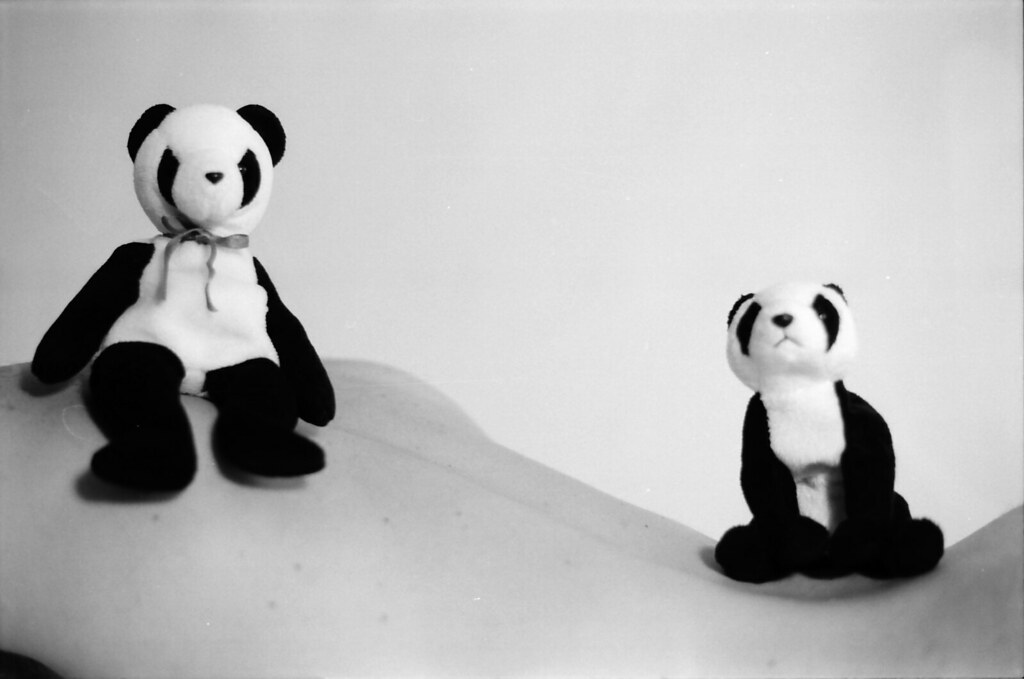
In Modern Society, the human body has become an intrinsically sexual, fetishised ideal. Modern culture seems to seems to obsess over the perfect shape and its gendered appeal.

In the 1970s Allen Teger did a photographic project entitled Bodyscapes, in which he decided to refashion the sensual object that is the human body into a seductive landscape. The curves of a woman's breasts become rolling hills; the masculine flatness of a man's back becomes a the setting for a motorcycle race.

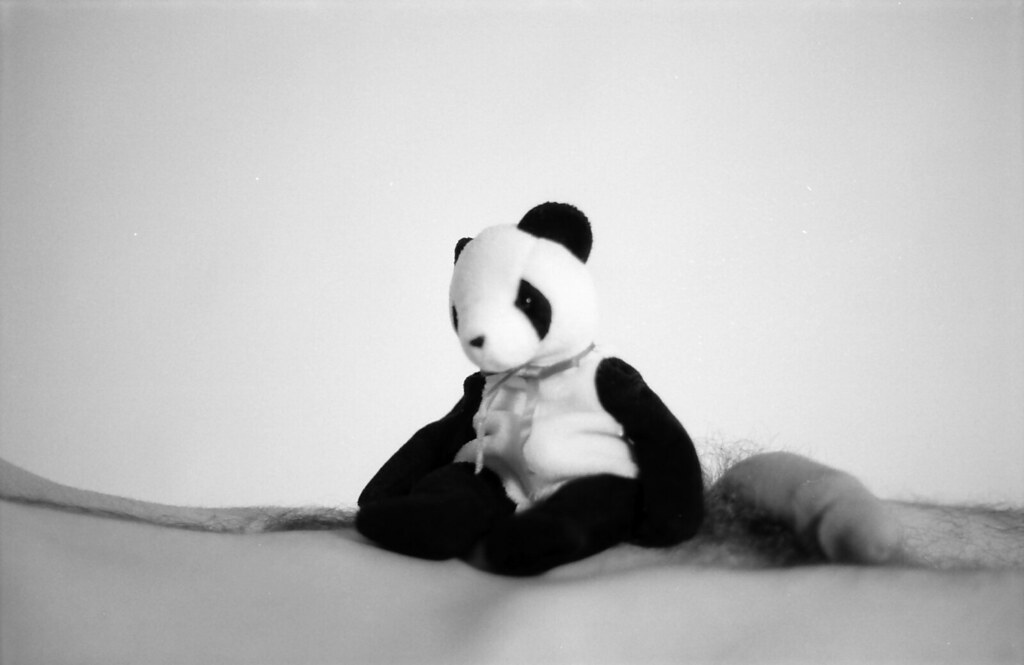
In my emulation of the self-same work, I decided to keep with the concept of 'the body as landscape' but to take the project's impetus in a different direction. Instead of embellishing the sensual nature of the body, with my models I tried to remove their inherent sexiness/sexualized gender; effectively trying to dehumanize them. I also choose to replace Teger's vintage plastic toys with stuffed animal pandas — the reasoning behind which is that the panda is often caricatured by the uninformed public as a docile and innocent. The inclusion of the cuddly panda then changes the nude from an abstract human form to a surreal landscape.

In this project the supremely innocent figure is presented on the naked body to explore preconceptions and perceptions; it is impossible to view and image and not make judgments and conclusions about it, but why?